
What Actually Happened
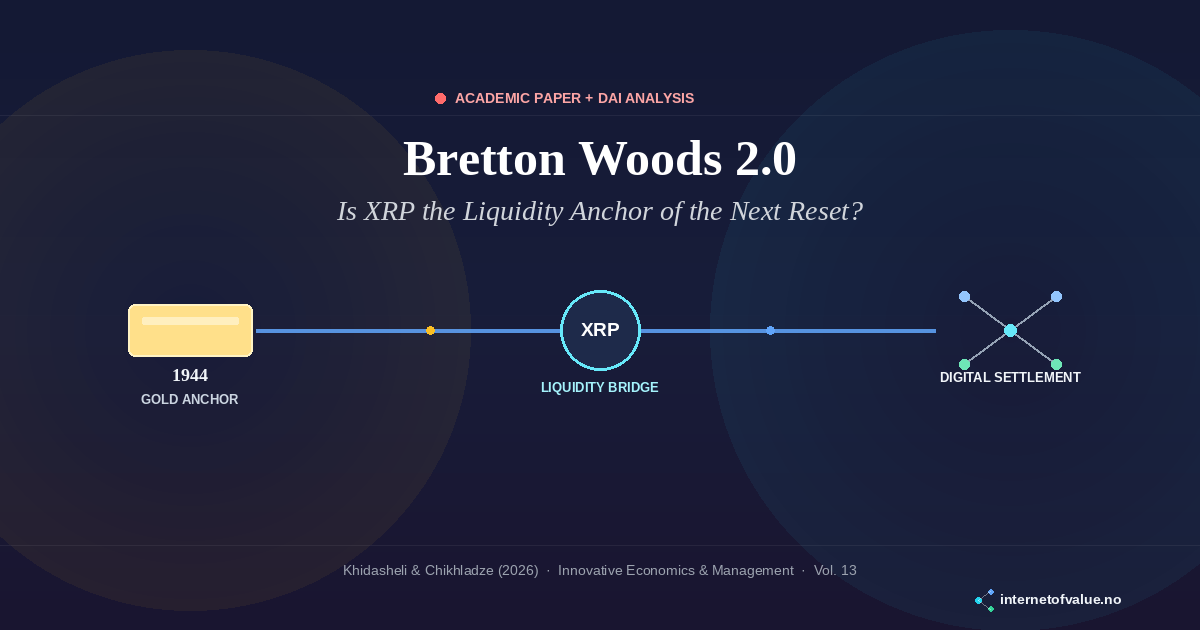
On June 2, 2026, the International Scientific Journal Innovative Economics and Management (Vol. 13, No. 1) published a peer-reviewed paper titled "Fragmentation and Digitalization: Outlines of a Looming Bretton Woods 2.0," by Mirza Khidasheli and Niko Chikhladze of the Central University of Europe and Akaki Tsereteli State University in Georgia (the country, not the US state).
Digital Asset Investor — the same XRP-focused YouTube channel we covered in our Susan Athey valuation article — found the paper and built a video around it titled "Leaked Bretton Woods 2.0 Plan: XRP Is The Liquidity Anchor."
What the Paper Actually Argues
Stripped of headline framing, the paper's core thesis is narrower than "XRP wins the reset." It argues that:
- The dollar-centric Bretton Woods architecture (1944–1971, then floating-dollar dominance since) is misaligned with a world that is simultaneously digitalizing and becoming geopolitically multipolar
- Historically, dominant settlement instruments (gold, then SWIFT) emerged from market adoption, not government design
- Bitcoin and XRP are presented as case studies — not prescriptions — of market-born instruments that could fill analogous roles: Bitcoin as a scarcity-based neutral reserve ("digital gold"), XRP as a real-time settlement bridge between currencies
- The authors explicitly state their goal is not to deliver "a fixed blueprint for the future" but to "promote informed discussion"
The XRP-Specific Claims — What's Actually Cited
The paper's case for XRP rests on a comparison table (RippleNet vs. SWIFTgpi) sourced from a 2019 Finance Magnates article, plus general claims about settlement speed and decentralization:
| Claim | Paper's Source | Our Note |
|---|---|---|
| 3–5 second finality | General XRPL design property | Accurate, well-documented |
| RippleNet has "instant calculation," SWIFTgpi doesn't | Shome, 2019 (Finance Magnates) | Comparison table is 6+ years old; SWIFT has iterated since |
| "Over $50 billion transferred through XRP corridors since 2023" | Not independently cited in the paper's reference list | This figure appears in DAI's narration, not with a traceable footnote in the paper itself |
| Bank of America, Santander use Ripple ODL, 60% cost reduction | Asserted in body text, no specific citation | Older, frequently-repeated industry claim; not freshly sourced here |
| BIS "explicitly cites Ripple's XRP as an example of a private settlement asset" | BIS, 2021 (BIS Papers No. 116) | This BIS paper is real and does discuss CBDC cross-border models — worth reading directly |
The strongest, most defensible part of the paper is the historical-monetary argument (gold → SWIFT → next instrument). The weakest part is treating XRP's specific adoption numbers as settled fact when several of the underlying figures are unsourced or several years old.
What Digital Asset Investor Adds That Isn't in the Paper
Watching the actual video makes clear that DAI layers several additional claims on top of the paper that aren't in Khidasheli & Chikhladze's text at all:
DAI also connects the paper to unrelated news in the same video: Ripple's preliminary MiCA approval in Luxembourg, the CLARITY Act's Senate timeline, and commentary from Anthony Pompliano and Dan Morehead (Pantera Capital) on Bitcoin reserve adoption by nation-states. These are all real, separately-reported developments — but none of them appear in the academic paper itself. The video's narrative power comes from weaving genuinely separate news items into one continuous story, which is a common and effective rhetorical technique, but worth recognizing as a technique.
Watch the Source Video
Two Real, Separately-Verifiable Developments From the Video
Even setting the Bretton Woods framing aside, two concrete items DAI mentions are independently checkable and genuinely relevant to XRP's institutional trajectory:
Our Verdict
The underlying academic paper is real, peer-reviewed, and makes a genuinely interesting historical argument about monetary transitions. Its treatment of XRP specifically is thin — a handful of claims, several without fresh citations, alongside a much more thorough discussion of Bitcoin, CBDCs, and BRICS settlement experiments.
The "leaked" framing is inaccurate — this is published academic literature, not insider information. The jump from "XRP is one of several illustrative case studies in an exploratory paper" to "XRP Is The Liquidity Anchor" (the video's title) is a significant amplification that the source material itself does not support as strongly as the title implies.
That said, dismissing this entirely would also be wrong. The paper's central argument — that digitalization and multipolarity are real, structural pressures on dollar-centric settlement — is a mainstream and well-cited position in monetary economics (Eichengreen, Rogoff, BIS research are all cited extensively). Whether XRP specifically benefits from that transition remains genuinely open, not proven by this paper alone.
Sources
| Source | Description | Link |
|---|---|---|
| Original Paper | Khidasheli & Chikhladze (2026), Innovative Economics and Management, Vol. 13 No. 1 | iem.ge ↗ |
| PDF Backup | Archived locally in case the journal site or PDF link changes | Download ↗ |
| DAI Video | "Leaked Bretton Woods 2.0 Plan: XRP Is The Liquidity Anchor" | YouTube ↗ |
| BIS Annual Economic Report 2026 | Chapter 3 — referenced in the video, separate from the academic paper | bis.org ↗ |
| BIS Papers No. 116 (2021) | Central bank digital currencies for cross-border payments — cited by the academic paper | bis.org ↗ |
| Ripple MiCA Luxembourg | Preliminary regulatory approval, 30 EEA countries | ripple.com ↗ |
| Our Calculator | Compare against the documented macro scenarios on internetofvalue.no | calculator.xrp ↗ |